
Modernizing Digital Experience Platforms: The Taxonomy-First Approach to Drupal 11 Migration
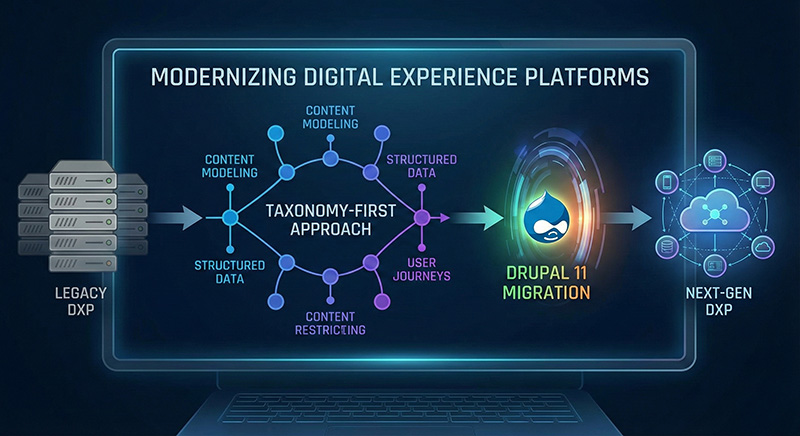
Upgrading to Drupal 11 is more than just a version bump; it’s an opportunity to modernize your entire digital experience platform (DXP). However, for many organizations, the migration process becomes a complex and chaotic exercise in rework, broken classifications, and lost relationships. The root cause: migrating first and cleaning up later.
The difference between a seamless, efficient Drupal 11 migration and a drawn-out disaster often comes down to one factor rarely given the spotlight: taxonomy. In this post, we’ll argue, with evidence and practical lessons, why a taxonomy-first approach isn’t optional. It’s the sturdy foundation of any Drupal 11 migration worth doing.
Why Traditional Migration Approaches Fail
The Taxonomy‑First Approach: What It Means and Why It
Taxonomy Debt: The Silent Migration Tax
Over the years, a live Drupal site accumulates what the community calls “taxonomy debt.” Editors habitually:
- create duplicate terms (typos, plural vs singular, inconsistent phrasing),
- retire vocabularies without removing references,
- tag content inconsistently across similar content types or sections.
By themselves, these issues might not cause major disruptions. But when you migrate, especially to a version as structurally rigorous as Drupal 11, these small inconsistencies become massive, multiplied problems:
- automated mappings fail,
- term references break,
- content lands in incorrect categories, or worse, gets orphaned.
In long-lived or enterprise-grade sites, it is common to encounter numerous taxonomy terms that require consolidation before migration. In complex or poorly managed sites, this challenge can become significantly more extensive.
If you skip taxonomy cleanup, or worse, delay it until after migration, your QA phase becomes a manual drag: chasing mislabeled content, inconsistent navigation, broken menus, faulty faceted search results. That’s a lot of time, cost, and user‑experience risk for problems that could have been eliminated from the start.
Migration Without Context = Risky “Lift‑and‑Shift”
Many organizations treat a migration as a mechanical data transfer: “dump the DB, run migrate scripts, map fields, and publish.” But that view misses the reality that most migrations also involve revisiting data models, correcting past mistakes, and adapting to new business requirements. When you migrate to Drupal 11, treat it as an opportunity to re-architect, not just upgrade.
Drupal 11 isn’t just another update; it's built to support modern web needs, including improved performance, API-first architecture, enhanced media handling, better multilingual and localization support, and cleaner site architecture.
If you migrate blindly, carrying over every misconfigured taxonomy, every redundant term, and inconsistent tagging, you not only bring forward existing technical debt, but also amplify it.
The Taxonomy‑First Approach: What It Means and Why It Works
What does a taxonomy-first approach look like in practice? Think of it as architect-level planning before execution. It means:
- auditing existing taxonomies and vocabularies,
- consolidating and cleaning up duplicate or obsolete terms,
- aligning taxonomy structure with current business needs and information architecture,
- mapping content to a clean, rationalized taxonomy before migration, and only then migrating data.
This approach, recently championed by thought leaders in Drupal migration, moves the taxonomy audit from being a post-migration cleanup chore into the core of the planning phase.
Benefits? Consider these outcomes:
- taxonomy becomes intentional, consistent, and predictable;
- automated migration tools map taxonomies reliably, fewer failures, fewer “unknown” categories;
- QA becomes a verification step, not a chaotic “find‑and‑fix-everything” scramble;
- post-migration content governance is easier, consistent tagging, search, navigation; manageable structure for future growth.
In short: you transform migration from a data-moving exercise into a strategic upgrade of your entire content architecture.
What Needs Auditing Before Drupal 11 Migration
When planning a taxonomy-first Drupal 11 migration, your audit checklist should include:
1. Full Taxonomy & Vocabulary Review
- Inventory all vocabulary and their usage across content types.
- Detect duplicate or redundant terms.
- Identify unused vocabularies or orphan terms.
2. Content Inventory & Field Mapping
- Catalog all content types, nodes, fields, taxonomy references, media, and custom entities.
- Evaluate which content types or fields need consolidation or restructuring. Maybe some content types can merge; some fields can be standardized. This streamlines the content model for the new site.
3. Define Taxonomy Purpose & Scope, Aligned to Business Goals
- Based on current and future content strategy (e.g., multilingual support, dynamic content, faceted search, personalization), redesign taxonomy architecture.
- Ensure vocabularies reflect your content strategy and site navigation in Drupal 11 (menus, sections, categories, tags, filters).
4. Clean-up & Consolidation
- Merge duplicate tags/terms.
- Delete obsolete or unused vocabularies/terms.
- Re‑tag content where needed so its classification aligns with the new taxonomy plan.
5. Document Everything - Before Migration Starts
- Maintain a clear mapping document: old taxonomy → new taxonomy, old content type → new, field mappings, term/concept changes.
- Document rules for term usage, naming conventions, structure guidelines, and content governance policy. This becomes your reference for future content operations.
This isn’t trivial, but it ensures your migration is not just an upgrade, but a transformation: cleaner, scalable, maintainable.
Drupal 11: The Right Time to Re‑architect
Migrating to Drupal 11 isn’t just a technical upgrade. It provides an opportunity to reassess content architecture, governance, and digital strategy. Drupal 11’s enhancements, improved media management, better multilingual and localization support, API-first architecture, and modern theming make it easier to build a DXP that’s future-proof, scalable, and efficient.
If you carry forward old taxonomy debt into Drupal 11, you lose much of that long-term value. On the other hand, if you migrate with a clean, rational taxonomy aligned with present and future business needs, you emerge with a content platform that’s far more agile, easier to manage, and ready for growth.
Common Pitfalls of Skipping Taxonomy‑First Approach
| Pitfall | Why It Happens | Consequence |
|---|---|---|
| Automated mappings fail or mis‑tag content | Duplicate or inconsistent taxonomy terms | Content ends up in wrong categories or becomes orphane |
| Faceted search & navigation broken | Terms not aligned with site structure | Poor user experience, lost content discoverability |
| Manual QA load skyrockets | Inconsistent tags, mis‑classified content, loose relationships | High cost, delayed launch, frustrated stakeholders |
| Increased long-term maintenance overhead | No governance or future‑proof structure | More issues as site grows; slower onboarding for new editors/developers |
| Loss of business & SEO value | Broken structure, inconsistent URLs, poor organization | Potential drop in search rankings, user dissatisfaction |
TThese are not theoretical risks, these are common real‑world issues that many organizations face post‑migration when they rush the process. The recent analysis published around Drupal migration highlights taxonomy debt as one of the primary reasons migrations drag on or suffer poor outcomes.
How We Approach Drupal 11 Migrations, Taxonomy First (Our Unique Methodology)
At Drupal Partners, we don’t treat Drupal migrations as “lift and shift.” We treat them as strategic replatforming, a chance to improve content architecture, future-proof your DXP, and give you a manageable system for years to come.
Here’s how we apply the taxonomy-first approach in our Drupal 11 migrations:
1. Discovery & Audit Phase
- Full content, taxonomy, field, and media audit
- Mapping document: existing structure → desired Drupal 11 architecture
- Stakeholder workshops to align business goals with taxonomy and content strategy
2. Taxonomy Re‑design & Clean-up
- Consolidate duplicate terms, prune unused vocabularies
- Design new vocabularies and classification systems if needed, optimized for site navigation, search, faceted browsing, SEO, and content governance
3. Content Remapping & Field Alignment
- Remap content types, fields, and taxonomy references
- Standardize metadata, URL slugs, field names, and relationships
4. Migration Execution
- With a clean taxonomy & content model in place, run migration using Drupal’s migration tools, ensuring high fidelity of content and relationships
- QA becomes verification, not a corrective marathon
5. Post-Migration Governance & Maintenance Guidance
- Documentation and guidelines for editors, rules for taxonomy usage, content tagging, naming conventions
- Ongoing support for future growth, content additions, and taxonomy evolution
This methodology reduces risk, increases conversion velocity, and ensures your Drupal 11 site remains organized, scalable, and easy to manage across teams and time.
Time Pressure Doesn’t Mean Skip Taxonomy, It Means Prioritize It
We often see clients under pressure to “just migrate”, with deadlines, budgets, and a need to modernize quickly. The instinct is to treat migration as technical work and push taxonomy cleanup to “later.” That’s a trap.
In reality, a taxonomy-first audit upfront often saves time and money overall.
Because when you fix taxonomy later, or skip it, the cost comes back multifold: inflated QA effort, manual cleanup, user frustration, broken navigation, and possibly loss of trust or credibility if content gets misclassified or lost.
So if you have a tight timeline, don’t shortcut taxonomy. Make it the anchor of your migration plan. Prioritize it, because it’s cheaper, faster, and wiser in the long run.
Get Your Drupal 11 Migration Right, Start With Taxonomy
If you’re planning a move to Drupal 11, or evaluating whether it’s time, we strongly recommend adopting a taxonomy-first migration strategy.
Contact us for a comprehensive Drupal 11 migration audit & readiness assessment. We will:
- review your existing content, taxonomies, and architecture,
- design a clean taxonomy plan aligned with your business goals,
- deliver a detailed migration roadmap, optimized for cost, performance, and long-term manageability.
Why Taxonomy‑First Is Your Smartest Migration Bet
Upgrading to Drupal 11 is not just about embracing the latest version; it’s about embracing a modern digital experience: one that is flexible, scalable, maintainable, and future-ready. But you can’t build a future-proof DXP on a cracked foundation.
A taxonomy-first approach ensures that your migration isn’t simply a technical milestone. It becomes a strategic transformation: eliminating legacy debt, streamlining content architecture, and giving you a clean, consistent platform built for growth.
If you skip that step, you might migrate, but what you’ll really be doing is carrying forward yesterday’s problems into tomorrow’s system.
Choose taxonomy-first. Choose Drupal 11 done right.