
AI in Higher Education: What University Leaders Should Fix First
A prospective student opens ChatGPT, types in their intended major, target city, and career goals. Within minutes, they have a shortlist of programs ranked by outcome data, alumni trajectories, and cost of attendance. They have already made their decision before they ever fill out an application.
Meanwhile, the university's enrollment team is still running the same campaign playbook from five years ago: print mailers, campus visit days, and email drip sequences designed to convince students to choose them.
The student does not need convincing. They need confirming.
This is the shift happening beneath the surface of higher education right now. The traditional enrollment funnel, built on persuasion and information asymmetry, is collapsing. Students are arriving with more clarity than ever, and universities that still operate as if they hold the information advantage are falling behind.
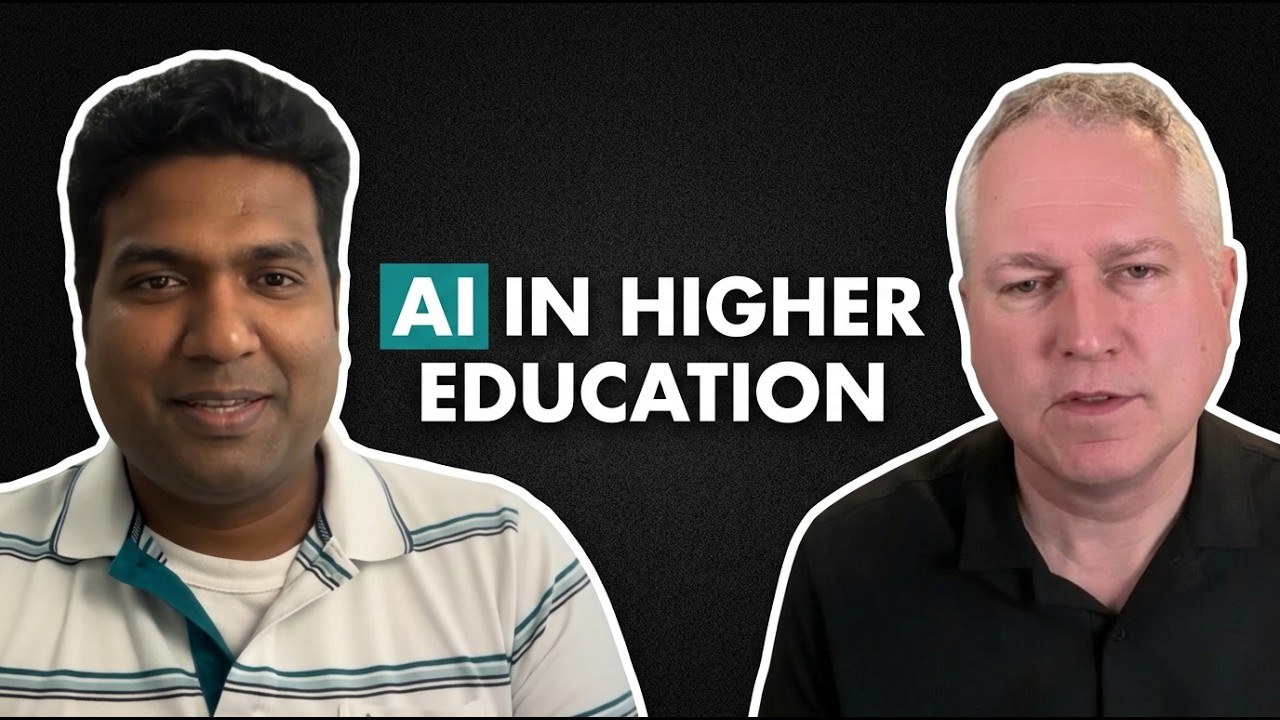
In AI Talks #2, we sit down with James Moore, Online Director and Associate Director of the DePaul AI Institute at DePaul University. His work sits at the intersection of online learning, digital marketing, and institutional AI strategy, giving him a front-row seat to how AI is reshaping the student journey from recruitment through graduation.

James Moore
James Moore is Online Director and Associate Director of the DePaul AI Institute at DePaul University in Chicago, where he works across online learning, digital strategy, and AI adoption. Originally from the UK, James brings nearly two decades of experience navigating the intersection of technology and higher education

Sathish Kumar Mariappan
Sathish Kumar Mariappan is Co-Founder of Drupal Partners, an Atlanta-based certified Drupal agency. He helps education, government, healthcare, and enterprise organizations with Drupal development, migration, AI consulting, and digital strategy, building secure, scalable digital experiences across complex ecosystems.
Episode Highlights
- → AI is not just changing classrooms. It is fundamentally reshaping how students choose, experience, and complete their education.
- → Universities should stop planning for growth by default. Some institutions need to plan for fewer students and figure out how to deliver the same value with a smaller incoming class.
- → The enrollment funnel has four pressure points where AI hits hardest: recruitment, conversion, retention, and experience.
- → Predictive AI for student retention sounds promising but carries real bias risks, especially when the models are black boxes that cannot be fully interrogated.
- → The scarcity that defined universities for centuries (knowledge, physical space, professor time) is disappearing. Experience is the one thing institutions can still compete on.
- → Curiosity, not credentials, is what hiring managers say they are looking for in candidates right now.
The Starting Point: AI Is Changing the Career Roadmap, and Universities Feel It First
The conversation opens with a question about how higher education has evolved during James's two decades at DePaul. His answer reframes the stakes immediately.
James: "It used to be that we would say to students, you know, plan for two or three different careers, but at least we know what those careers are. Now universities are saying plan for six or seven different careers and maybe 60% of those haven't been defined yet."
The entire value proposition of higher education has historically rested on a promise: come here, study this, and you will be prepared for a known set of career paths. That promise is harder to make when the career paths themselves are being invented and destroyed faster than curricula can adapt.
James sees the response not as doubling down on specific skills, but as cultivating something more durable.
James: "The trick now I think in higher education is preparing students to have a deep level of critical understanding but the ability to be curious and nimble to sort of see where the new opportunities are evolving and to be able to move into that space in a way that's meaningful and productive."
The implication for institutions is clear. Programs built around rigid career pipelines will struggle. Programs that teach adaptability, critical reasoning, and the ability to learn new tools quickly will be better positioned for a job market that no one can fully predict.
AI is reshaping higher education right now.
Student engagement, enrollment strategy, and digital experience are changing as AI becomes part of how universities operate. In this episode, we discuss what institutions are doing today and what they must prepare for next.
The DePaul AI Institute: Ethics at Scale
Sathish: What is the reason for you guys to create the AI institute and what role does it play in shaping AI adoption?
James: "We have this concept of Vincentian personalism. And if you were to simplify that concept, it's the idea that if you can be helpful to one person, you need to provide the same values and outcomes at scale when helping many people."
This is not just institutional branding. It is a design principle that shapes how DePaul approaches AI. The question is not "how do we adopt AI?" but "how do we adopt AI in a way that scales human respect?"
James: "We may not be developing frontier and foundation models here at DePaul but we're part of that ethical thought leadership conversation to make sure that our students come out of the university here with a deep understanding of AI and the ability to understand where and when it should be used in their careers and life going forward."
The AI Institute acts as a focal point across disciplines. In the college of business, market realities demand hands-on AI experience. In the theater school or creative writing department, the relationship with AI is entirely different. But the principle holds: even if a discipline decides AI is not the right tool, students should arrive at that conclusion through direct experience, not avoidance.
Where Most Universities Actually Stand on AI Adoption
Sathish: In your opinion, where do other universities stand on the AI adoption journey?
James: "There's a huge disconnect between universities saying that this is important and then saying we're working on it. They're typically sort of in the middle area and that I think is a dangerous place to be because universities are like ocean liners."
The middle ground James describes is where most institutions are stuck right now. They acknowledge AI matters. They have formed committees. They may have hosted a symposium or two. But they have not made the structural decisions required to move.
The danger is not inaction for its own sake. It is that the environment is moving fast enough that delayed decisions compound into strategic disadvantage.
Internal communication gaps make it worse. Without a clear institutional picture of where the university is headed with AI, individual departments improvise, and that improvisation rarely adds up to a coherent strategy.
The Enrollment Funnel: Four Places Where AI Hits Hardest
This is where the conversation gets concrete. Sathish asks whether AI can help with recruitment, conversion, and retention. James breaks the enrollment funnel into four distinct stages, each affected differently.
James: "My personal feeling at the moment is a lot of institutions are planning for growth and have done historically and I think that's a dangerous thing to do. I think for some institutions they should plan for actually reduced students and from that work out how they can still provide the same services."
From there, he walks through each stage:
1. Recruitment: Lower Costs, Smarter Spend
James: "The old adage in marketing is 50% of my marketing isn't working but I don't know which 50%. So used well AI is a way to identify where what you're spending money on isn't working."
AI gives enrollment marketing teams the ability to see which channels, messages, and audiences are actually producing results. But James frames this as the smaller opportunity.
2. Conversion: The Student Already Decided
James: "Traditionally the role of the university has been to convince a prospective student that this is the place to come. That conversation has changed. Now prospective students know before they apply what they want, how they're going to get it, and the right place to go."
This is the most significant shift in the funnel. Students are using AI to do their own research, compare programs, and arrive at a decision before they ever submit an application. The university's job is no longer persuasion. It is confirmation and smooth onboarding.
3. Retention: Promising but Dangerous
James: "AI is probably going to reduce attrition because students are going to come in with a better understanding of the institution."
Students who arrive with clearer expectations are less likely to leave. But James raises a sharp warning about using predictive models to flag at-risk students.
James: "The systems that most platforms are moving towards are generative and those are black boxes. We don't at the moment have a mechanism where we can see how those algorithms are producing results and that can be dangerous when we predict student behavior. We might be statistically elevating certain biases."
If the model cannot be fully interrogated, and the data feeding it cannot be validated, predictions about which students are "at risk" may encode the very biases the institution claims to be fighting.
4. Experience: The Only Remaining Competitive Advantage
James: "Artificial intelligence is changing the economies of scale. An institution is competing against basically essentially free. You can't compete on cost, but you can compete on experience."
When knowledge is free and accessible, and online delivery removes the physical plant constraint, the only thing a university can offer that AI cannot replicate is the human experience itself. James points to what DePaul calls "high-touch moments": those specific periods in a student's life when the institution creates something transformative.
James: "If you think back to your university, your college career, there were probably certain moments when you realized, ah, this is why I'm glad to be here. That's what we need to provide."
AI is changing higher education faster than expected.
Student engagement, enrollment, and digital experience are being reshaped by AI across universities. In this episode, we discuss what institutions must do now to stay ready for what’s next.
Student Engagement: The Scarcity Problem AI Finally Solves
Sathish: Can AI improve student engagement both inside and outside the classroom?
James builds his answer around a concept that reframes the entire history of higher education: scarcity.
James: "If you think about the way that universities have operated historically is that they have scarce resources. You've got the professor and her or his time. You've got the institution in terms of physical plants and then maybe you've got scarcity of knowledge in terms of books."
Three types of scarcity have defined the university model for centuries. AI is eliminating them one by one:
- • Scarcity of knowledge disappeared with the internet. Information is now freely available online.
- • Scarcity of physical space was reduced by online learning. Growth is no longer bound by the number of seats in a lecture hall.
- • Scarcity of the professor's time is what AI addresses now. The professor's ability to respond meaningfully and quickly to every student has always been the bottleneck.
Two research findings anchor why this matters:
Rapid feedback produces the best learning outcomes. When a student asks a question and waits hours or days for a response, the learning value of that response drops significantly. AI enables in-the-moment feedback.
Students retain only four or five things per hour of instruction at peak capacity. Most university classes run two to three hours, flooding students with more than they can absorb. AI can help pace and personalize that delivery.
But James flags the risk clearly:
James: "The fear that I have is if you rely on AI to do much of the work that the professor does, at a certain point the student says, why do I need the professor? I'm going to use the AI."
This is the tension every institution must navigate. AI can reduce the bottleneck of professor availability. But if it reduces the professor's role too far, it undermines the very experience that justifies the institution's existence.
Personalized Learning: Powerful, but Only When the Student Owns It
Sathish: Do you think AI-powered tools will help in creating personalized learning experiences?
James: "The way that most traditional universities and colleges teach is a way that was developed by the Prussians sort of 200 years ago. You put 50 people in a room, there's one professor, you do something for two or three hours, learning happens. And we know that that isn't the best way for learning to happen."
AI has the capability to fix this. Different students learn at different speeds, at different times of day, through different modalities. The Prussian model was never designed around the learner. It was designed around the constraint.
But James draws a critical distinction about where personalization becomes truly powerful:
James: "The artificial intelligence when it becomes a personal device, something that the student has complete autonomy of, that's when I think it becomes most useful."
The fear he identifies is rational: students may not want to hand their deepest learning patterns, struggles, and habits to a system owned and operated by someone else. The most effective AI tutor would be one the student controls entirely, one that knows their schedule, their cognitive rhythms, and their goals.
James: "It's James, you know, it's 12:00. Now would be a really good time for you to start work on your project because it's due tomorrow and based upon experience, 12:00 is when your brain is firing."
That level of personalization requires trust. And trust requires ownership.
Online Education: Two Paths Diverging at the Same Time
Sathish: How will AI change the future of online and hybrid education?
James surfaces a tension that most institutions are only beginning to process. Two forces are pulling online education in opposite directions simultaneously.
The Faculty Fear
Agentic AI and deepfake technology mean a student could potentially ask an AI agent to complete an entire online course on their behalf. The integrity systems that took 15 years to build are now vulnerable in ways that did not exist two years ago.
James: "For some professors, the fear is an online course is something that a student could ask their agent to complete. It's like, hey, here's my course. Go in, read the assignments, do the assignments, give me a B+ because I don't want it to look like I'm cheating."
The Student Expectation
At the same time, students are beginning to expect what AI makes possible: ubiquitous, accurate, personalized feedback available around the clock.
James: "AI now changes that equation from the student's perspective for something that is highly personalized. The path that they follow with online learning is going to be very specific to their needs."
The institutions that will lead in online education are the ones that can hold both realities at once: designing for integrity while delivering on personalization. Neither can be sacrificed for the other.
What Separates Strong Online Programs from Weak Ones
Sathish: What separates the best online educational universities from the weaker ones?
James: "Some online programs are merely a collection of courses. You take an accountancy course, you take a finance course, but there's no trajectory. There's no arc from one course to another course."
The distinction is programmatic design versus course aggregation. A strong online program works like a narrative. Concepts introduced early are referenced and built upon later. The student experiences a coherent journey, not a disconnected series of checkboxes.
James: "If you go to the cinema and you watch a movie, you're not watching a selection of individual things. You're watching something that has a narrative that brings you from beginning to end. The truly superlative online programs do the same thing."
Will AI Close the Gap Between Elite and Non-Elite Institutions?
Sathish: Do you think AI will allow any university to compete with elite universities?
James is direct:
James: "I'm cynical here. I think the gap between the elites and the non-elites will probably widen. And the reason for that is the elites have money and money fixes a lot of problems."
He references Gartner's magic quadrant as a framework. Elite institutions have both completeness of vision and resources. Non-elite institutions may have vision but lack the resources to execute at the same pace.
But he adds an important counterpoint:
James: "AI empowers the individual to have more opportunity. I definitely think folks who are coming from disadvantaged backgrounds, AI is going to be perhaps more transformative to people who are coming from comfortable backgrounds."
The institutional gap may widen. But the individual gap may narrow. AI as a personal tool is a democratizing force, even if AI as an institutional tool tends to favor those who can spend the most.
Scenario Planning: The Strategy Universities Actually Need
Sathish: What should universities start doing today to stay relevant?
James: "They need to do scenario planning. Scenario planning works on the assumption that there are uncertainties that are significant at some point in the future."
He names the uncertainties that should be driving planning right now: international student enrollment instability, the potential arrival of AGI and ASI (artificial super intelligence), and a political and economic environment that is shifting faster than five-year strategic plans can accommodate.
James: "What universities need to do is think about possible futures and then think about how they would respond to each of those possible futures and have at least a plan in place. That way as those futures become less uncertain, they can move in a way that makes sense."
The traditional strategic plan assumes a stable trajectory. Scenario planning assumes multiple possible futures and prepares responses for each. In an environment this volatile, the latter is far more useful.
His second recommendation is just as important: universities need to be more nimble.
James: "When we went through the pandemic that pushed a lot of universities into being more nimble. We need to be in that environment again."
The Skill That Gets You Hired: Curiosity
Sathish: What skill set should students acquire for the future?
James draws from two recent events at DePaul. At a business symposium, hiring decision-makers from different organizations and experience levels were asked what they look for in candidates. A week later, a specialized AI hiring firm was asked the same question.
James: "They all said the same thing. Curiosity. When they're looking to hire someone, if they can demonstrate intellectual curiosity, that's the thing that gets them the job."
His advice to students is specific and actionable:
James: "One of the best things that I think students can do at the moment is to use these tools to create something that's meaningful. You could use that to create an app that does something that doesn't exist at the moment. You could use that to create a learning path for yourself. But it's this concept of being curious and then demonstrating that you've taken that curiosity and done something meaningful with that."
Curiosity alone is not enough. Demonstrated curiosity, curiosity that produces something tangible, is what separates candidates.
The Future of Higher Education: Fewer Institutions, Same Importance
James: "I think there is a substantially good future for higher education. It's so important. But at the moment we have significant threats against it. I think we're going to have fewer universities and colleges here in the US. We have roughly 5,000. We're going to have fewer in the future, but we're still going to have higher education because it does something that is significantly important."
He ties this back to something personal:
James: "In the same way that I'm a parent, I'm a parent because I have faith in the future. I think that the world is ultimately going to be good because I wouldn't have a child otherwise."
Higher education changes lives. It improves culture and society. Those functions do not disappear because AI arrives. But the number of institutions delivering on that promise will shrink. The ones that survive will be the ones that adapted.
Advice for Leaders Feeling Overwhelmed
James: "The way that we address that issue where you're feeling overwhelmed, I think, is a mental condition where you need to feel that you have some control over your environment. One of the ways that we can demonstrate that we have control is through meaningful actions."
His advice is not about solving the whole problem. It is about taking the first step.
James: "It could be that you don't necessarily fix the problem, but you take that first step. So let's imagine something is happening in your life that's hugely disruptive and you're feeling stressed because you don't have control over that. If you can make that first step, now you feel less stressed."
That first step could be forming a committee, playing with a tool, or simply having the conversation. The point is movement. Movement restores the sense of agency that overwhelm takes away.
His closing thought brings it home:
James: "Find a good way that you can entertain at least the concept of work-life balance. Get out into nature, spend some time talking to someone. Put down your device, cook a meal from scratch. Do something that's slow and has value. And make sure you're able to provide those things daily, weekly, and just talk to people without technology at least for an hour."
What Higher Ed Leaders Should Do Now
AI is already reshaping how students choose, experience, and complete their education. Institutions that act now will be positioned to lead. Those that wait will face harder choices later.
- Stop defaulting to growth assumptions.Some institutions need to plan for fewer students and figure out how to deliver value at a smaller scale.
- Audit your enrollment funnel through an AI lens.Understand how AI is changing recruitment spend, conversion dynamics, retention signals, and the student experience.
- Compete on experience, not cost.Knowledge is free. Physical space is optional. The human experience is the one thing AI cannot replicate. Double down on high-touch moments.
- Approach predictive AI for retention with caution.If you cannot fully interrogate the model and validate the data, you risk encoding bias into decisions that directly affect students.
- Invest in programmatic online design.A collection of courses is not a program. Build narrative arcs that connect learning outcomes across the full student journey.
- Start scenario planning now.Map out multiple possible futures and prepare responses for each. Five-year plans built on stability assumptions are no longer sufficient.
- Encourage curiosity as a core competency.For students and staff alike, the ability to be curious, experiment, and produce something meaningful from that curiosity is the most valuable skill in this environment.
Ready to Build an AI-Ready Digital Campus?
At Drupal Partners, we help universities and institutions navigate AI-driven digital transformation with secure, scalable solutions:
- • Building AI-enhanced Drupal platforms that support institutional readiness and governance frameworks
- • Developing secure, high-performing digital experiences for education, from student portals to faculty systems
- • Integrating AI-powered tools into existing Drupal ecosystems for operational efficiency and personalized learning
Keep the Conversation Going
This is AI Talks #2 by Drupal Partners, inside stories and strategies from leaders navigating the shift to AI, automation, and the digital infrastructure they require.