
The Drupal Visibility Stack: SEO, AEO, GEO, AIO, and SXO in the AI Era
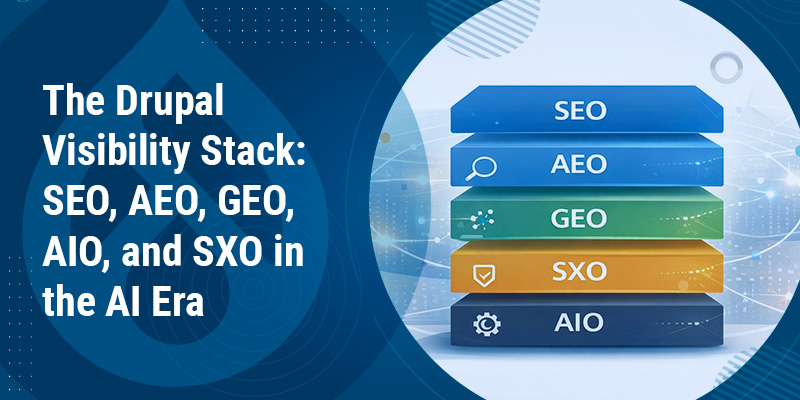
Most teams still treat “visibility” as a ranking problem. That assumption breaks the moment discovery flows through answer boxes, AI summaries, internal search, and task-focused journeys that never resemble “ten blue links.”
For Drupal site owners, the challenge is sharper: you are not managing a blog. You are managing a living knowledge system with multiple editors, policy surfaces, templates, and content types. When discovery becomes answer-led, the thing that wins is not just keyword coverage. It is content certainty: the ability for machines and humans to extract the same correct meaning every time.
Google’s own guidance for AI features reinforces the direction of travel: AI experiences can generate summaries while linking users to explore the web, which raises the bar on how cleanly your site communicates facts, constraints, and page intent.
This is where the five terms in this article help, if you treat them as a stack. Each one optimizes a different point where your content gets selected, interpreted, or acted on.
Table of Contents
- A practical definition of each term
- The Drupal Visibility Stack
- When to prioritize each layer
- Drupal patterns that reduce AI-era failure modes
- Measuring impact
- Governance: preventing contradictions from becoming “the answer”
- Key takeaways and next steps
- FAQ
1. Definitions, translated into Drupal reality
SEO (Search Engine Optimization)
Ensures your Drupal content is discoverable and competitive in ranked search: crawlability, indexability, page intent clarity, internal linking, and authority signals.
AEO (Answer Engine Optimization)
Ensures your most important questions can be answered accurately by extraction-based systems. Think: quote-ready definitions, explicit constraints, and consistent answers across pages and documents. Featured snippets are a widely understood example of extraction behavior.
GEO (Generative Engine Optimization)
Ensures your content is included and represented correctly when systems synthesize responses from multiple sources. GEO is formalized in research as optimization for visibility within generative engines, not just ranking.
AIO (AI Optimization)
Uses AI to improve the operating capability behind your program: editorial throughput, QA, governance, classification, refresh cycles, and monitoring. In Drupal terms, AIO is about keeping a large estate consistent without slowing publishing to a crawl.
SXO (Search Experience Optimization)
Ensures discovery turns into outcomes: task completion, form completion, subscription, registration, donation, purchase, or qualified inquiries. SXO is where “found it” becomes “finished it.”
2. The Drupal Visibility Stack
A useful way to run these five is to assign them non-overlapping responsibilities. The goal is to stop arguing over acronyms and start removing the specific constraint blocking outcomes.
Layer 1: SEO is the eligibility layer
If search engines cannot reliably crawl, understand, and index your important pages, nothing else matters. SEO makes your Drupal estate eligible to be surfaced.
Layer 2: AEO is the answer integrity layer
When users ask direct questions, answer systems pull content that is explicit and stable. AEO is about reducing ambiguity, surfacing constraints early, and consolidating the authoritative answer so it can be quoted without distortion.
Layer 3: GEO is the narrative fidelity layer
When a system synthesizes, it compresses and generalizes. GEO is about ensuring that compression still preserves your actual meaning: your scope, exclusions, requirements, and differentiators. The risk is not only “missing out.” The risk is being summarized incorrectly.
Layer 4: SXO is the outcome layer
Even perfect discovery fails if users cannot validate quickly or complete the task. SXO addresses the post-click and on-site journey, especially for high-intent pages where hesitation and drop-off happen.
Layer 5: AIO is the operating layer
This is what prevents your program from turning into a one-time project. AIO improves how fast you can publish, fix, and refresh without creating contradictions and duplication across content teams.
DrupalPartners already packages much of this stack into a single audit motion: SEO, performance, AI visibility, UX, journeys, personalization, upgrades, migrations, and security, with prioritized deliverables.
3. When to Prioritize Each Layer
Use these triggers as a prioritization framework, not a checklist.
Prioritize SEO when eligibility is uncertain
Do this when:
- key sections are under-indexed or inconsistent in visibility
- taxonomy and URL patterns create duplicates and thin variants
- templates are generating pages that compete with each other
What you are trying to prevent:
- “We have the content, but it does not surface reliably.”
Prioritize AEO when correctness drives trust or compliance
Do this when:
- the same question is answered differently across pages, PDFs, or departments
- critical answers include conditions, deadlines, exceptions, or eligibility rules
- your help desk or call center sees repeated confusion that originates on the site
What you are trying to prevent:
- “Visibility went up, but the wrong interpretation became the answer.”
Prioritize GEO when summaries shape decisions before users visit you
Do this when:
- users arrive with a pre-built viewpoint and you need to correct assumptions fast
- your offerings are easy to oversimplify into generic claims
- your site has multiple “about” narratives that subtly disagree
What you are trying to prevent:
- “We are included, but we are represented as something we are not.”
Prioritize SXO when you already attract demand but lose outcomes
Do this when:
- organic landing pages have traffic but weak completion rates
- users bounce after reading because the next step is unclear
- the path to validate requirements, process, or proof is too long
What you are trying to prevent:
- “We win discovery, then lose conversion because validation is hard.”
Prioritize AIO when scale is the bottleneck
Do this when:
- updates are slow because review is manual and inconsistent
- multiple teams publish overlapping content without shared vocabulary
- the estate accumulates content drift after every policy, product, or program change
What you are trying to prevent:
- “We ship faster by publishing more, then spend months cleaning up contradictions.”
4. Drupal patterns that reduce AI-era failure modes
These are not “SEO tips.” They are structural moves that Drupal is uniquely good at.
Pattern A: Build “single source of truth” content types for high-stakes topics
If a policy, requirement, or process is referenced from multiple places, the truth should not live as copy-pasted paragraphs across dozens of pages. Drupal content modeling is built to avoid this, but many estates do not use it consistently.
Pattern B: Enforce metadata and page intent at scale
Drupal’s Metatag module exists specifically to systematize structured metadata across pages and content types, which supports search understanding and consistent SERP presentation.
Pattern C: Use moderation workflows to protect correctness
Drupal’s Content Moderation module supports multiple states and review transitions, allowing a working copy to be reviewed while a published version stays live. This is a governance lever, not just an editorial convenience.
Pattern D: Treat on-site findability as part of the visibility stack
In many Drupal estates, internal search and navigation are where users confirm details and complete actions. Weak internal findability creates “false bounces”: users arrived correctly, but could not validate quickly.
Pattern E: Make AI an enforcement layer, not a copy generator
DrupalPartners’ Drupal AI consulting positioning explicitly includes personalization, intelligent search, and content automation. The highest-leverage use of AI here is governance and discoverability: classification, QA, consistency checking, and accelerating refresh cycles across the estate.
5. Measuring Impact
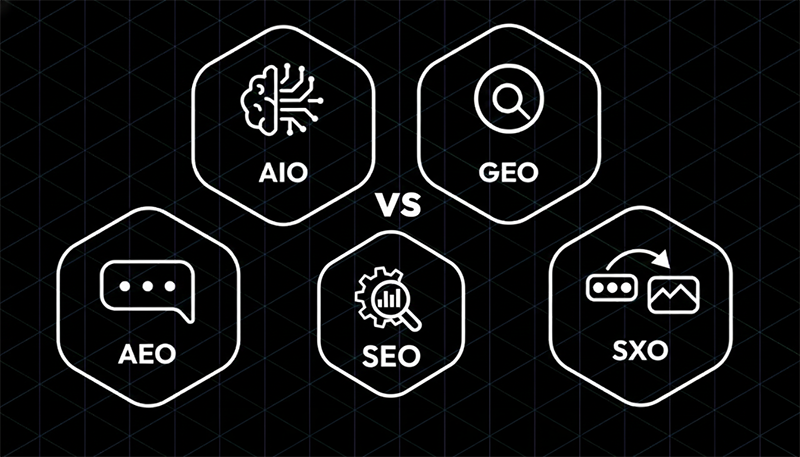
If you cannot connect metrics to outcomes or risk reduction, you will lose alignment.
SEO metrics that matter
- index coverage for priority sections
- organic entry performance by intent cluster (not single keywords)
- concentration: how much outcome comes from the top landing cohorts
AEO metrics that matter
- do your canonical answers match across all pages where they appear?
- answer capture tests for a fixed set of high-stakes questions
- reduction in confusion-driven contacts for those question clusters
GEO metrics that matter
- inclusion and accuracy checks using a stable prompt set for category, comparison, and “how should we” queries
- are your constraints and exclusions preserved in summaries?
- citation or link occurrence where the surface provides it, since AI experiences may present links for deeper exploration
SXO metrics that matter
- completion rate by landing cohort
- drop-off points on high-intent paths
- time-to-validation: how quickly a user can confirm requirements and next steps
AIO metrics that matter
- time-to-refresh for critical pages after changes
- QA defect rate: contradictions, duplication, outdated facts
- editorial cycle time from change request to publish
6. Governance: preventing contradictions from becoming “the answer”
In answer-led discovery, contradictions are no longer a minor editorial issue. They become a ranking, extraction, and synthesis problem all at once. If two pages disagree, the system does not negotiate. It selects.
A governance baseline that scales on Drupal:
- one canonical page per critical topic
- named owner and review cadence
- controlled vocabulary for key terms and entities
- consolidation of duplicative pages rather than parallel maintenance
- workflow gating for high-risk content using moderation and revision discipline
Drupal does not just support governance. It can enforce it, if you model content accordingly.
Get a Drupal AI Visibility Audit
If your Drupal site has strong content but inconsistent source-of-truth pages, visibility can rise while accuracy and outcomes slip. Our audit identifies technical, content, UX, and AI visibility issues, then delivers a prioritized roadmap your team can execute.
Key Takeaways and Next Steps
Key takeaways
- These five terms are not competitors. They are layers in a visibility stack.
- Drupal estates win in AI-era discovery when content certainty is engineered, not assumed.
- AEO and GEO success is usually limited by governance and consistency, not by publishing volume.
- SXO is often the fastest lever when you already attract qualified discovery but lose completion.
- AIO is the scaling layer that keeps velocity from creating content drift.
Next steps
1. Identify the 25–50 questions that drive outcomes or risk.
2. Map where each answer lives today, then isolate contradictions and duplicates.
3. Create canonical truth pages for the highest-impact topics with clear constraints and explicit definitions.
4. Align templates, metadata, and taxonomy so your estate communicates consistent meaning at scale.
5. Establish a measurement harness: fixed question set, fixed prompt set, and outcome tracking by landing cohort.
6. Add workflow gating for high-risk content so updates do not fragment across teams.
FAQ
1. Does AI-era discovery mean SEO is less important for Drupal sites?
No. SEO remains the eligibility layer. If your content is not discoverable and indexable, it cannot be reliably surfaced for AI features that link users to explore the web.
2. Where do Drupal sites typically fail on AEO?
They store the “truth” in too many places: duplicate policy pages, copied paragraphs across hubs, and PDFs that conflict with web pages. Extraction systems reward clarity and consistency.
3. What is the practical difference between AEO and GEO in day-to-day work?
AEO is about making one answer safe to quote. GEO is about making your broader narrative safe to summarize. Both fail when terminology and constraints are inconsistent.
4. How do we handle content that must remain in PDFs?
Keep PDFs for full fidelity, but move the decision-critical definitions, requirements, and exceptions into structured web pages so discovery systems can retrieve and quote them reliably.
5. How do we speed up updates without increasing risk?
Reduce the number of pages that must be “perfect.” Consolidate into canonical truth pages, enforce moderation workflows, and use AI to detect contradictions before publishing. Drupal’s content moderation model is designed for reviewed revisions.