
Intent-Driven Personalization in Drupal: A Practical Framework to Lift Engagement and Conversions
By 2026, personalization will be standard for Drupal sites. Traditional engagement methods, such as static content and generalized messaging, are no longer enough. The future is in delivering intent-driven, personalized experiences that adapt to users’ behaviors and deliver tailored content in real-time.
In this blog post, we’ll explore how Drupal can harness the power of intent-driven personalization to elevate user engagement and conversions. We will cover practical strategies, real-world applications, and the steps to implement AI-powered personalization that increases ROI successfully.
What Exactly Is Intent-Driven Personalization?
Intent-driven personalization goes beyond segmenting content based on broad demographic data. Instead, it tailors the user experience based on individual behaviors, interests, and intent. This real-time approach helps deliver content and offers relevant to a user's current needs, enhancing the journey and increasing the likelihood of conversion.
Why Intent-Driven Personalization Matters for Drupal
Drupal is known for its flexibility and scalability, making it the ideal CMS for implementing advanced personalization strategies. However, traditional personalization techniques like segmenting users based on demographics (age, location, etc.) or behavior (clicking on specific products) fall short in today’s fast-moving landscape.
Want to see AI-powered personalization in action?
Check out our exclusive webinar, where we cover key AI strategies and real-world applications that you can implement today.
With AI and machine learning technologies becoming more accessible, Drupal sites now have the ability to move beyond static, page-based content. By leveraging intent-driven personalization, Drupal sites can deliver highly relevant, timely, and personalized content based on real-time data and insights, increasing the likelihood of conversion.
5 Core Components of Intent-Driven Personalization in Drupal
Implementing intent-driven personalization in Drupal involves a multi-layered approach that blends various technologies and strategies. Let’s break down the core components needed to drive this shift in your site’s user experience:
1. Real-Time User Behavior Tracking
The first step in intent-driven personalization is capturing and analyzing real-time user behavior. This means monitoring how users navigate through your site, what they click on, what they leave behind, and their interaction with specific content.
For example, if a user visits a product page multiple times but never completes a purchase, it’s a clear sign of interest, and you can trigger personalized content to address their hesitation.
2. AI and Machine Learning for Dynamic Content Delivery
AI and machine learning algorithms play a critical role in understanding user intent. By analyzing historical and real-time data, these technologies can predict what a user is most likely to engage with next and dynamically adjust the content they see.
Machine learning models can identify patterns, such as which products tend to be bought together, or which features are most important to specific segments of users. Based on this data, AI can recommend products or content, trigger personalized offers, and display contextual messaging, all in real-time.
3. Context-Aware Search with AI
Search functionality is at the core of Drupal’s user experience. In many sites, search is the gateway to products and information. However, traditional keyword-based search is often ineffective at understanding the nuanced intent behind a user’s query. This is where AI-powered search, enabled by natural language processing (NLP), comes into play.
AI search in Drupal takes into account the context of a user’s query, allowing for more intelligent search results. NLP enables the search engine to understand user queries beyond basic keywords, resulting in more relevant and contextually appropriate results.
4. Predictive Analytics for Conversion Optimization
Predictive analytics uses past behavior to forecast future actions. For Drupal sites, this can mean predicting when a visitor is most likely to abandon their cart or leave the site without converting.
Predictive models can trigger personalized messages, display exit-intent popups, offer discounts, or recommend similar products, each based on the user’s past interactions. For example, if a visitor has added items to their cart but hasn’t checked out, AI could trigger a message offering a discount or alerting them to low stock levels, creating a sense of urgency.
5. Automating Content and Offers
By integrating AI with your Drupal site’s existing tech stack, you can automate content delivery and promotions, saving time and improving efficiency. Automation can be applied to various aspects of the site, including email campaigns, personalized product recommendations, content distribution, and even pricing strategies.
Drupal integrates easily with marketing automation tools like Mailchimp and HubSpot, which can use AI to create targeted email campaigns based on user intent.
Similarly, dynamic pricing algorithms can adjust prices in real-time based on user behavior, inventory levels, and competitor pricing, ensuring your offers remain competitive and personalized.
How to Implement Intent-Driven Personalization in Drupal: A Step-by-Step Framework
Now that we’ve discussed the core components of intent-driven personalization, let’s explore a step-by-step framework for integrating this strategy into your Drupal site.
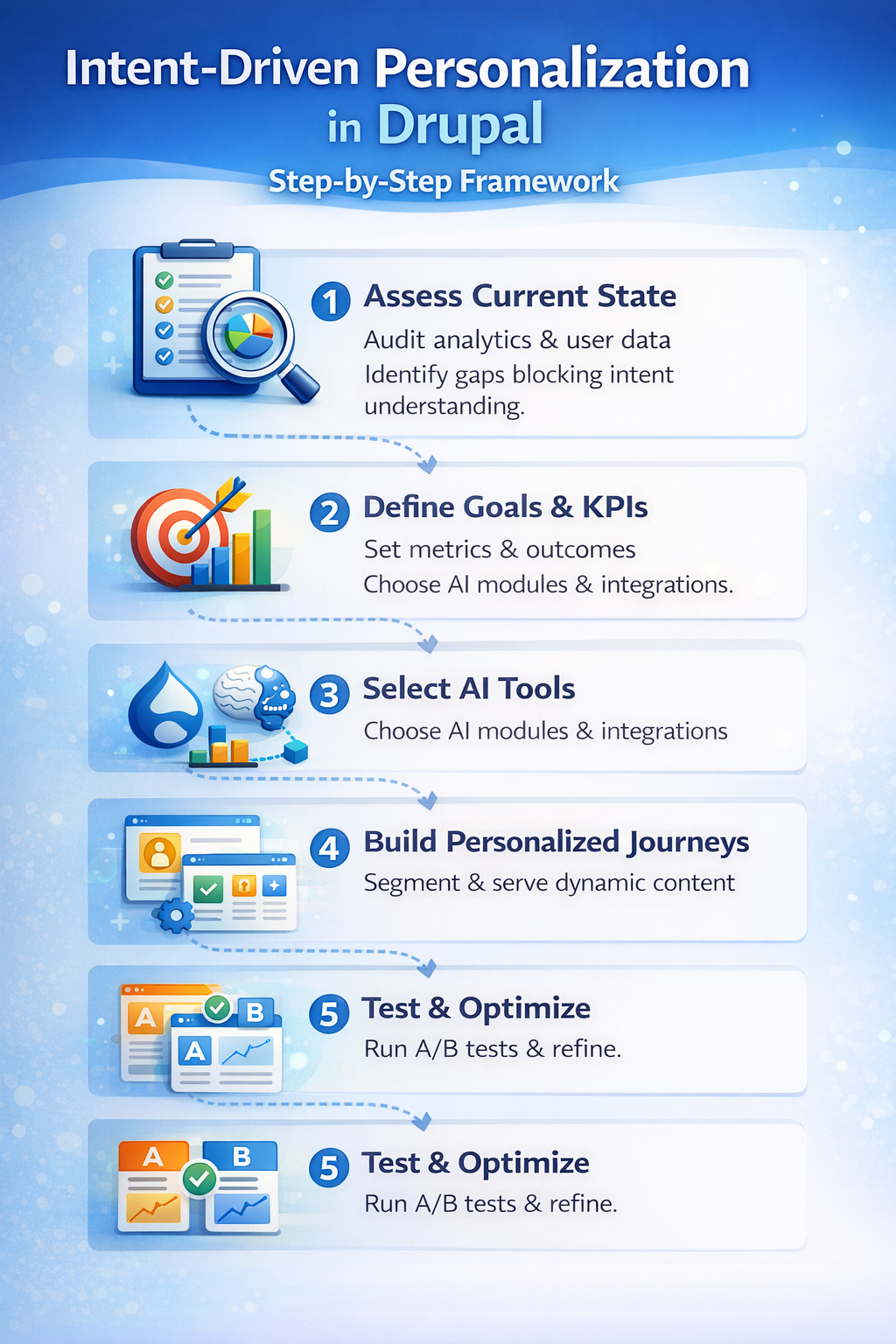
1. Assess Your Current State
Before implementing AI-driven personalization, take a moment to assess your current personalization efforts. Do you have the right analytics tools in place? Are you capturing the necessary user data to inform your personalization strategies? If not, start by integrating advanced analytics and tracking tools into your Drupal site.
2. Define Clear Goals and KPIs
To measure the effectiveness of your intent-driven personalization efforts, it’s essential to define clear goals and KPIs. Are you aiming to reduce cart abandonment rates? Increase average order value? Boost return visits? Set specific metrics to track, such as conversion rates, bounce rates, and engagement levels.
3. Choose the Right AI Tools and Integrations
Based on your goals, select the appropriate AI tools and integrations for your Drupal site. Consider modules that can integrate machine learning models, such as Drupal Commerce AI for personalized product recommendations, or third-party platforms that offer AI-powered features like visual search, chatbots, and predictive analytics.
4. Create Personalized User Journeys
Map out personalized user journeys for your audience segments. For example, new visitors might be shown introductory content and offers, while returning customers might see personalized product recommendations based on their previous purchases. Implement these journeys with the help of AI tools, ensuring that each step in the user journey is optimized for engagement and conversion.
5. Test and Optimize
Once your intent-driven personalization strategies are in place, don’t forget to continuously test and optimize. A/B testing is crucial in understanding what works and what doesn’t. Test different content types, promotional strategies, and even AI-driven models to see which yields the highest ROI.
Final Thoughts
Intent-driven personalization is no longer a luxury for Drupal sites; it’s a necessity. By embracing AI and machine learning, you can create personalized, context-aware experiences that resonate with your users and drive higher engagement and conversions.
As we look toward 2026, Drupal will continue to evolve, with AI playing an integral role in shaping the future of personalized user experiences. Implementing these strategies today will not only future-proof your Drupal site but also ensure that you remain competitive in an increasingly crowded digital landscape.
Are you ready to implement intent-driven personalization in your Drupal site? Contact Drupal Partners today to learn more about how we can help you integrate AI into your platform and drive measurable growth.
FAQs
How do I use AI for personalization in Drupal?
AI can be integrated into Drupal through tools like AI-based content modules and machine learning frameworks. These technologies allow for personalized content delivery based on real-time user behavior.
What benefits does AI-powered personalization bring to Drupal?
AI-powered personalization enhances user engagement, increases conversion rates, and reduces cart abandonment by delivering dynamic, context-aware content that matches users' needs in real time.
How can AI improve Drupal site search?
AI-powered search in Drupal enhances the search function by understanding the intent behind user queries, delivering more relevant and contextually accurate results.
How can predictive analytics help my Drupal site?
Predictive analytics uses past behavior to anticipate future actions, allowing you to engage users with personalized offers or messages at critical points in their journey, improving conversion rates.